4 min read
Why Roofing and Exterior Contractors Lose Leads Through Their Websites
Service areas, proof, tap-to-call, heavy photo galleries and slow follow-up: the website gaps that cost roofing contractors estimate requests.
NNebula Webtech
Roofing and exterior contractors lose leads through their websites for a handful of fixable reasons: the site does not show the service area, there is no fast way to request an inspection or estimate, the work is not proven with real photos and credentials, the pages are slow on a phone, and nobody answers promptly after the form is sent. Homeowners compare several contractors in minutes, so small gaps decide who gets the call.
Short answer: A roofing website wins leads when a homeowner can see in seconds that you serve their town, trust your work, and request an estimate with one tap. Most lost leads come from missing proof, slow mobile pages, buried phone numbers and slow follow-up.
How do homeowners actually choose a roofer?
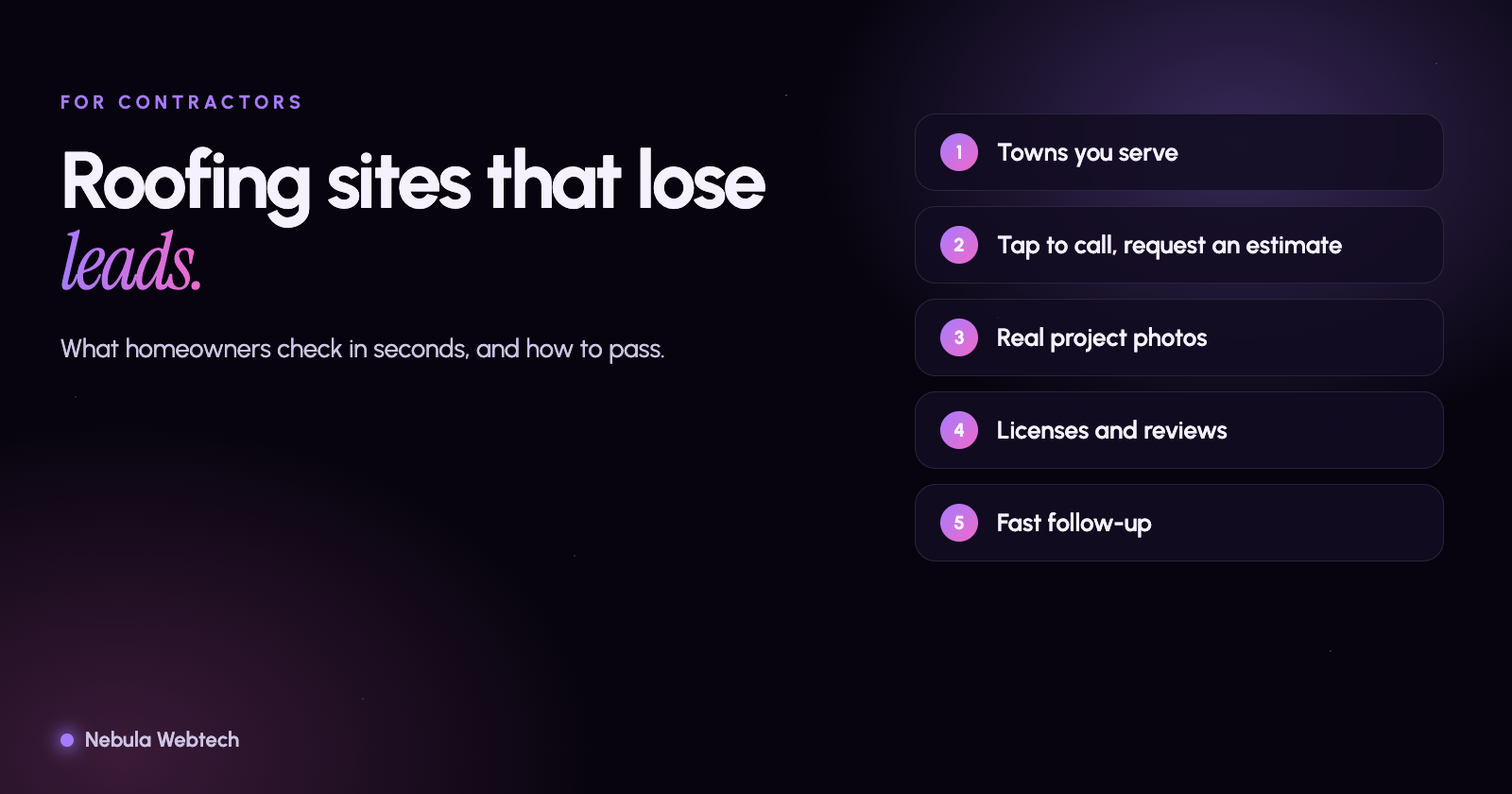
Most people search when something has already gone wrong: a leak, storm damage, an aging roof, or an insurance claim. They search on a phone, open several results, and contact the one that looks real, local and responsive. They are not reading your whole site. They are checking five things:
- Do you work in my town?
- Are you licensed and insured?
- Have you done work like mine?
- How do I reach you right now?
- What happens after I contact you?
If your site cannot answer these on the first screen or two, they go back to the results and choose someone else.
Where do roofing websites leak leads?
The service area is vague
"Serving the greater Chicago area" is not a town. Create a page for each major town or county you serve, with real content about jobs there, local building considerations and photos from nearby projects. Keep your Google Business Profile service areas consistent with these pages.
No obvious next step
Put a tap-to-call number and a "Request a free inspection" button in the header, visible on every page and every screen size. Repeat the action after each section. A single "Contact us" link in the menu is not enough for someone with water coming through the ceiling.
Proof is thin or generic
Stock photos of smiling roofers do not build trust. Use your own project photos with a short note on what was done, where, and what material was used. Show the credentials that apply to your state and local rules, such as contractor licensing, insurance and manufacturer certifications you actually hold, and link to review profiles where customers can verify what they say. If you do not have a number of reviews yet, ask recent customers to leave honest ones.
Emergency and storm work are mixed with routine work
A homeowner with an active leak and a homeowner planning a replacement have different needs. Give emergency repairs their own page and form, with your real response process, and a separate page for replacements with materials, process and what to expect.
Slow, heavy pages on a phone
Galleries of full-size photos are the usual cause. Compress images, serve modern formats such as WebP, set width and height so the layout does not jump, and lazy-load photos below the fold. Google's published "good" thresholds are 2.5 seconds or less for Largest Contentful Paint and 200 milliseconds or less for Interaction to Next Paint. See how to find technical SEO issues for a checklist.
Slow follow-up
A fast, polished site is wasted if the form goes to an inbox nobody checks. Send an instant confirmation, route new requests to a phone as well as email, and decide who replies and how fast. After hours, tell people exactly when to expect a response, or offer a text option. We cover this in how to stop losing customer inquiries after business hours.
What should a roofing homepage include?
- A headline with the service and area, for example "Roof repair and replacement in Palatine and nearby suburbs"
- Tap-to-call number and an estimate or inspection request button
- Services: repair, replacement, gutters, siding, storm damage
- Real project photos and short descriptions
- Licenses, insurance and warranty details you can document
- Review excerpts with links to the source
- Service area towns
- A short, plain explanation of how an estimate works
- A form with a few fields and a clear promise of what happens next
Frequently asked questions
Do roofing companies need a separate page for each town?
Where you genuinely work and have something specific to say, yes. Pages should be useful to homeowners in that town, not the same text with the name swapped.
Should I show prices?
You do not have to publish exact prices, but explaining what affects cost (roof size, pitch, materials, tear-off, permits) helps visitors trust you and sends you better-informed leads. Our article on website pricing takes the same approach.
How important is my Google Business Profile?
Very. Many local searches for contractors are answered by the map results, so keep your name, address, phone, hours, services and photos accurate and consistent with your website.
Get a roofing website that turns searches into estimates
We build websites for home-service businesses with the local pages, proof and fast forms described above. Request an industry-specific proposal, or start with a free website audit to see where your current site loses visitors.
- Home services
- Local SEO
- Industry