4 min read
Questions to Ask Before Hiring a Website Development Company
Twenty-four questions on ownership, scope, process, SEO, speed, accessibility and support, plus red flags and a fair way to compare proposals.
NNebula Webtech
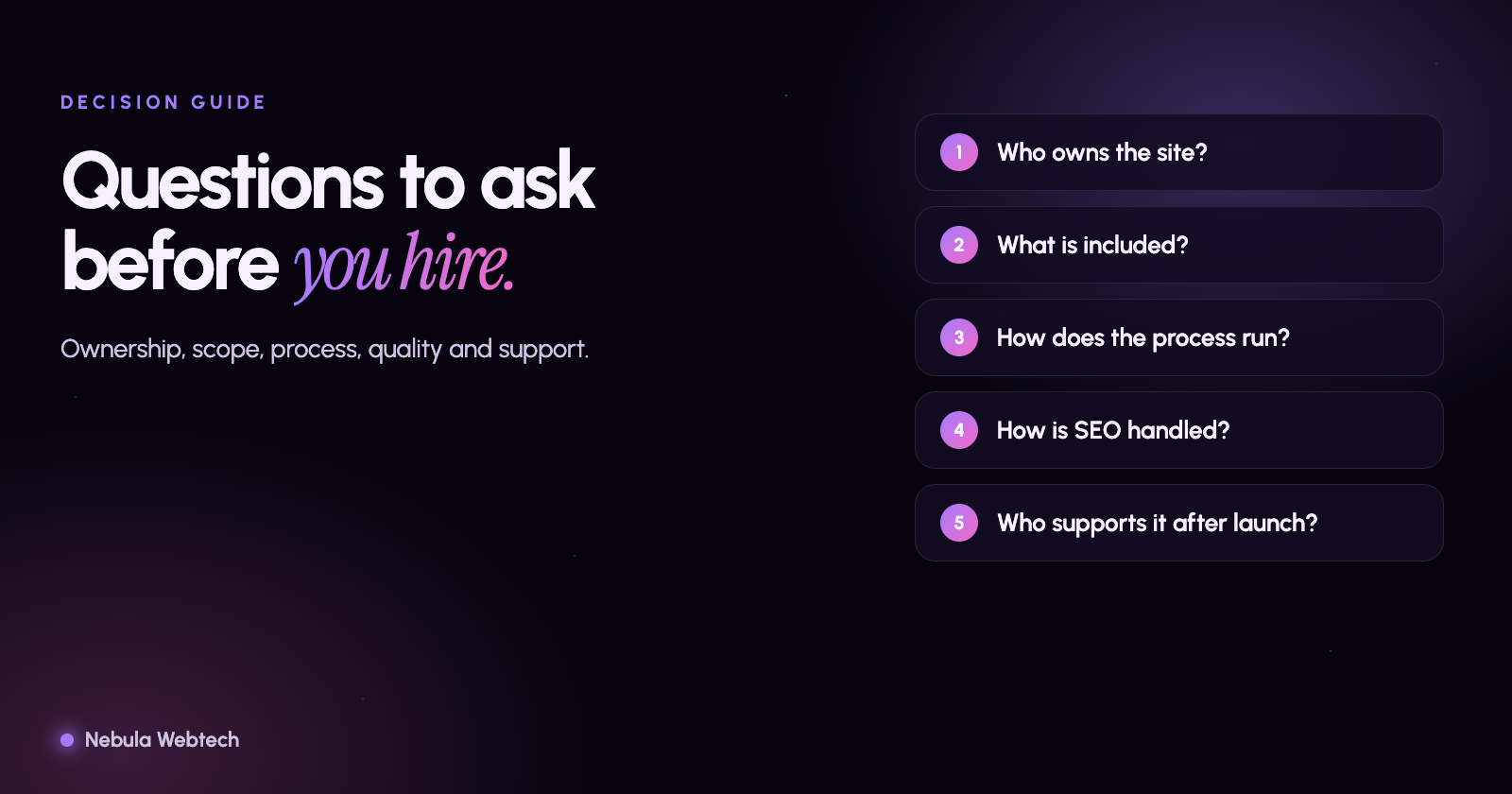
Before you hire a website development company, ask who will own the site and accounts, what exactly is included in the price, how the project and timeline will run, how they handle SEO, speed, accessibility and security, who supports the site after launch, and to see relevant past work you can verify. Their answers, and how openly they give them, tell you more than the proposal's design mockups.
Short answer: Good companies welcome detailed questions. Use the list below to compare proposals on ownership, scope, process, quality, support and cost, not only on price and visuals.
What should you ask about ownership and access?
- Who owns the website, design and code when the project is paid for? You should. Get it in writing.
- Will the domain and hosting be registered in my name? They should be, or you should have full administrative access.
- Will I receive all logins and a backup when the project ends? A reputable company hands over everything.
- Are there licenses, plugins or themes with ongoing fees? Ask for a list and the annual cost.
- What happens if we part ways? You should be able to leave without being locked in.
What should you ask about scope and price?
- What exactly is included? Number of pages, custom or template design, content writing, photography, forms, integrations and training.
- What is not included and billed separately? Hosting, maintenance, stock photos, plugins, change requests after launch.
- How are changes handled? Ask for the process and the rate.
- Is the price fixed or estimated? If it is estimated, ask what could change it.
- What are the payment milestones? Be cautious of large upfront payments with no checkpoints.
Our guide to how much a small business website costs explains typical ranges and the costs people forget.
What should you ask about process and timeline?
- Who will I work with day to day? A named contact, not a ticket system only.
- What are the stages, and what do you need from me at each? Content and approvals are the usual cause of delays.
- How long will it take, and what is the plan if either side is late?
- Will I see the site before launch? You should get a working preview to test on desktop and mobile.
- How do you test? Ask about browsers, phones, forms, accessibility and speed.
What should you ask about search, speed and quality?
- How do you handle SEO? A good answer covers page titles and headings, clean structure, redirects from old URLs, structured data, a sitemap and analytics. Be wary of anyone who guarantees rankings; nobody can.
- How will you protect my current rankings if this is a redesign? Redirect mapping is essential. Our redesign checklist shows what to protect.
- What speed targets do you build to? Google's "good" Core Web Vitals thresholds are 2.5 seconds or less for Largest Contentful Paint, 200 milliseconds or less for Interaction to Next Paint, and 0.1 or less for Cumulative Layout Shift.
- How do you approach accessibility? WCAG 2.2 AA is the common standard, and accessible sites serve more customers and reduce legal risk.
- How is the site secured? Ask about HTTPS, updates, backups and how forms are protected.
What should you ask about support after launch?
- Who looks after the site once it is live? Ask about maintenance, monitoring and response times. Read why a maintenance partner matters.
- What happens if the site goes down at night or on a weekend?
- Is there a warranty period for bugs after launch?
- Will you train me or my staff to update content?
How do you check their track record?
- Ask for two or three live sites similar to yours, and visit them on your phone.
- Check that the work is theirs and that the sites are still maintained.
- Speak to a past client if they will connect you, and ask about communication, delays and honesty on cost.
- Look at their own website. If it is slow, outdated or hard to use, take note.
Red flags
- No written contract or unclear ownership
- Guaranteed rankings or traffic
- Refusal to share logins or backups
- Prices far below every other quote with no explanation
- Pressure to sign immediately
- No plan for support or redirects
How to compare proposals fairly
Put each proposal in a table with the same rows: scope, timeline, price, ownership, support, SEO and speed work, and what is excluded. A cheaper proposal that leaves out content, redirects or support is not actually cheaper.
Frequently asked questions
Should I choose the cheapest company?
Not automatically. Compare what is included and who will support the site after launch. Fixing a poor build costs more than building it properly.
How many quotes should I get?
Three is a sensible number to compare scope and approach.
Do I need a contract?
Yes. It should cover scope, price, schedule, ownership, and what happens if the project ends early.
Talk to us before you decide
We are happy to answer every question on this list. Request a project estimate and we will explain the scope, timeline and ownership plainly, or review a proposal you already have. See our web design and development services.
- Web design
- Pricing
- Small business