4 min read
How Restaurants Can Increase Direct Orders Through Their Own Websites
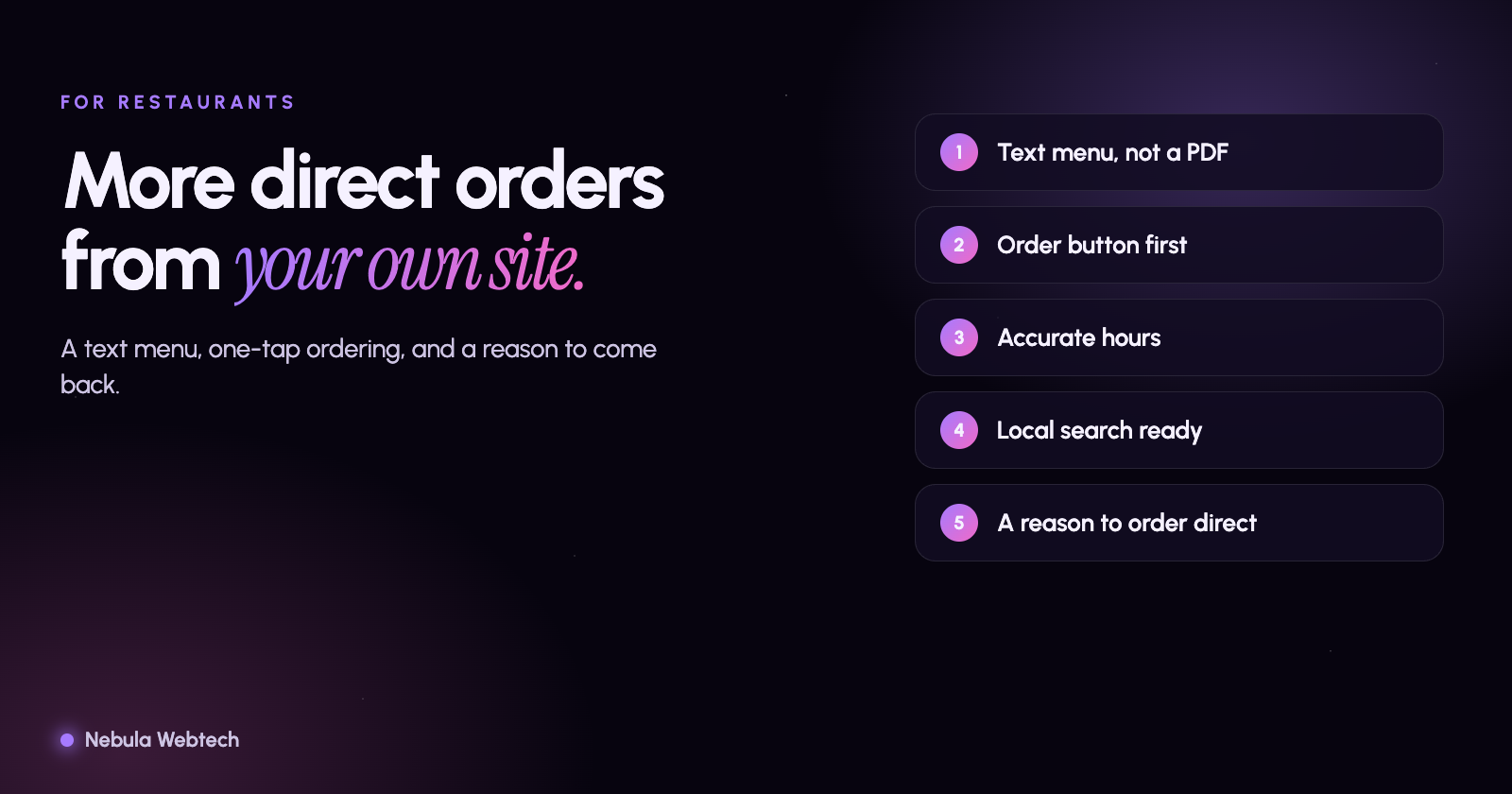
A text menu, an obvious order button, accurate hours, local search and a real reason to order direct: how restaurants can win orders on their own site.
NNebula Webtech
Restaurants can increase direct orders by making their own website the easiest place to order: a fast mobile menu, a clear "Order now" button, simple checkout, accurate hours and pickup or delivery details, strong local search presence and a reason for regulars to order direct. Direct orders matter because third-party delivery apps usually charge commissions, while your own ordering keeps more of the sale and the customer relationship.
Short answer: Make ordering from your own site faster and friendlier than the apps, keep your Google Business Profile and menu accurate, and give returning customers a simple reason to come back directly. Check the fees in your own agreements to see what each channel really costs.
Why do direct orders matter?
Delivery marketplaces bring in customers, but they charge fees that vary by plan and can take a significant share of each order, and they control the customer relationship. Orders placed on your own website or app give you the customer's contact details (with permission), your own branding and control over pricing, packaging and promotions. Read your platform agreements and compare the true cost per order for each channel before deciding where to put your effort.
What does a good restaurant website include?
A menu people can actually use on a phone
Most restaurant visits begin on a phone. Use real text, not a PDF or an image of a menu. Text menus load fast, can be read by Google and screen readers, and are easier to keep accurate. Group dishes clearly, mark allergens and dietary options, and show prices. Keep photos of your own food, compressed so pages load quickly.
An obvious ordering path
Put "Order pickup" or "Order delivery" as the first button on the home page and in the header. Keep checkout short: pick items, choose pickup or delivery time, pay, done. Offer guest checkout, and show totals and fees before the final step.
Accurate hours, address and contact information
Wrong hours cost orders and reviews. Show current hours, holiday changes, phone number, address and a map. Keep them identical across your website, Google Business Profile, social profiles and listings.
Local search that brings people to you
- A complete Google Business Profile with correct categories, photos, menu link and ordering link
- A page for each location with its own address, hours and menu
Restaurantstructured data that matches what is visible on the page- Real reviews, and replies to them
- Pages that load quickly and work well on phones; see how to find technical SEO issues
A reason to order direct
Do not rely on guilt. Give people something real: a loyalty reward, an exclusive item, a small discount code that you can afford, faster pickup or a catering option. Promote it on packaging, receipts, signs and email or text (with consent).
How do you set up online ordering?
You have three broad options:
- A restaurant ordering platform that integrates with your point of sale. Quick to launch, with monthly or per-order fees; check them carefully.
- An ordering plugin or module on your own website, with your payment processor.
- A custom ordering experience built to match your menu, kitchen workflow and branding.
The right choice depends on volume, menu complexity and how your kitchen handles tickets. Whatever you choose, test an order from start to finish on a phone, and make sure the kitchen actually receives it.
What about accessibility and policies?
Make the site usable with a keyboard and screen reader, with readable contrast and large tap targets (WCAG 2.2 asks for at least 24 by 24 CSS pixels). Publish clear policies for refunds, allergies, delivery area and wait times. Keep payment handling with a reputable processor so card details never touch your own server.
How do you know it is working?
Track orders by channel, average order value, repeat customers, abandoned carts and the fees you pay per channel. Review monthly. If direct orders are low, test one change at a time: button placement, checkout length, menu clarity or the incentive.
Frequently asked questions
Should I leave the delivery apps?
Not necessarily. Many restaurants use them for discovery while steering regulars to direct ordering. Choose based on your real margins.
Do I need an app?
Most restaurants do well with a fast mobile website. An app makes sense for high volume and loyalty features.
Can you connect ordering to my kitchen system?
Often, yes. It depends on your point of sale. We would review it first.
Build your own ordering channel
We create fast, mobile-first websites and ordering workflows for restaurants. Request a restaurant proposal or start with a free website audit.
- Restaurants
- Local SEO
- Industry