3 min read
Why Your Small Business Website Is Slow and How to Fix It
Oversized images, extra scripts, heavy plugins and crowded hosting cause most slow sites. How to measure, what to fix first and how to keep it fast.
NNebula Webtech
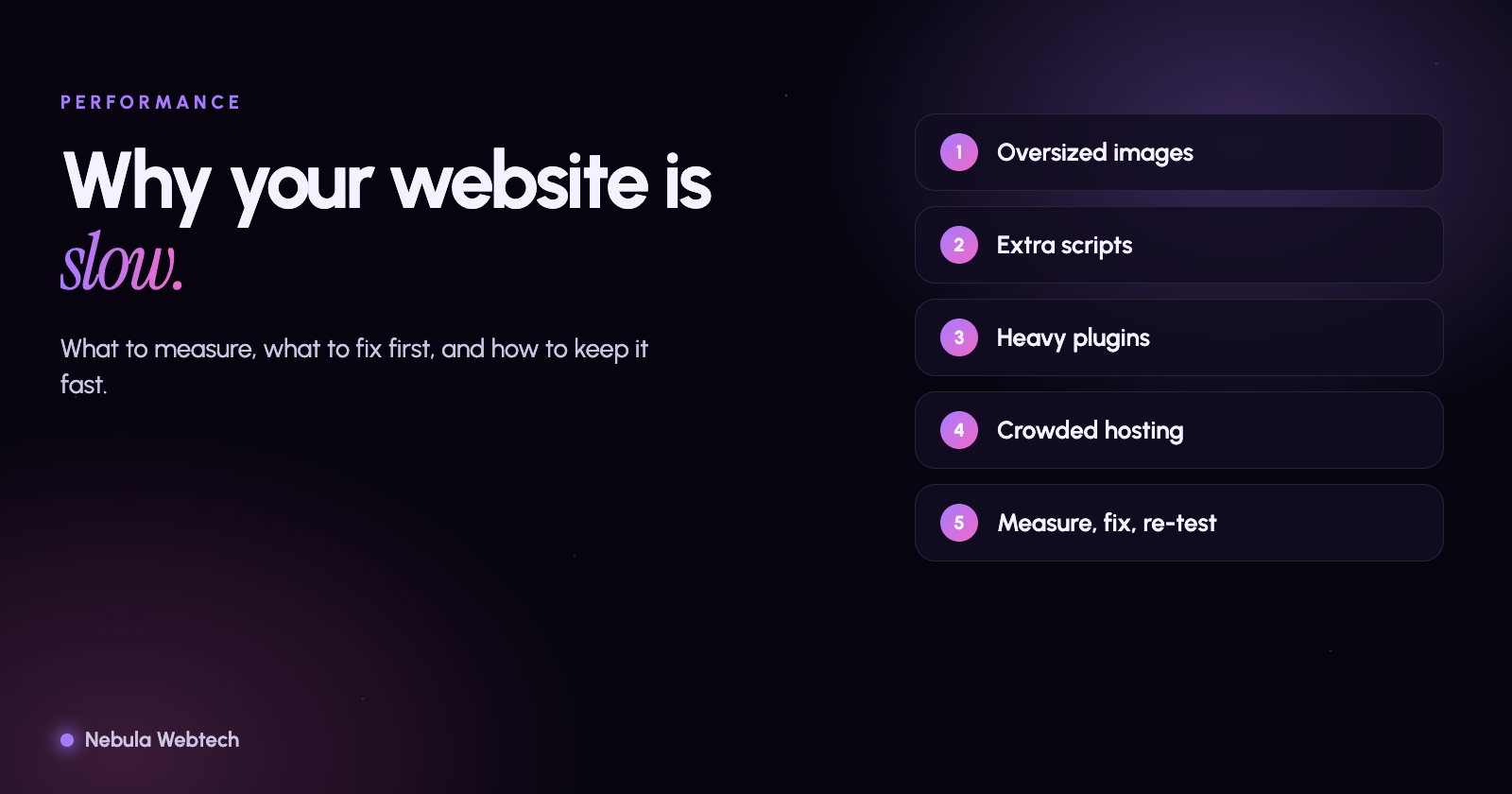
Most small business websites are slow for the same few reasons: oversized images, too many scripts from third parties, cheap or overloaded hosting, and a theme or plugin stack that does more than the site needs. The fixes are usually not a rebuild. Start by measuring, then compress images, remove what you do not use, and check your hosting.
Short answer: A page that loads in a couple of seconds on a phone keeps visitors and gives Google no reason to hold you back. A page that takes six seconds loses people before they read a word.
Why does speed matter?
People leave slow pages, and they do it on their phone, on a weak signal, often while deciding whether to call you or a competitor. Google also uses page experience as one of many signals. Speed alone will not make a weak page rank, but a slow page makes everything else harder.
How do you measure it?
Use Google's PageSpeed Insights. Enter a page address and read the mobile result first. Three measures matter most, and Google calls them Core Web Vitals:
- Largest Contentful Paint (LCP): how long the main content takes to appear. Under 2.5 seconds is good.
- Interaction to Next Paint (INP): how quickly the page responds when someone taps or clicks. Under 200 milliseconds is good.
- Cumulative Layout Shift (CLS): how much the page jumps around as it loads. Under 0.1 is good.
Test your home page, your busiest service page and your contact page. A speed test run once is noisy, so run it a few times and look at the pattern.
The usual causes, and the fixes
Images that are far too large
A photo straight from a phone can be several megabytes. Resize images to the size they are shown, save them in a modern format such as WebP, and let browsers load smaller versions on smaller screens. This one change often makes the biggest difference.
Too many third-party scripts
Chat widgets, tracking pixels, social feeds, pop-ups and old marketing tools each add requests. List every script on your site, ask what each one earns, and remove the ones that do not pay for themselves. Load the ones you keep after the page is usable.
Heavy themes and plugins
A theme that ships features you never use, and a long list of plugins, slows every page. Remove unused plugins, replace several small ones with a single tool where that is safe, and keep the rest updated. If a site depends on a page builder that loads a large amount of code for simple pages, a lighter template may be worth it at the next redesign.
Slow or crowded hosting
Very cheap shared hosting can respond slowly when many sites share one server. If your server takes a long time to start sending the page, no front-end tuning will fully fix it. Ask your host about caching, a content delivery network and a current version of PHP, or move to a plan with more headroom.
Fonts and layout jumps
Too many font files slow the first view, and images without set dimensions make the page jump as they load. Use one or two font families, load only the weights you use, and set a width and height on images and embeds.
What to fix first
- Compress and resize the biggest images on your top three pages.
- Remove scripts and plugins you do not use.
- Turn on caching and compression if your host offers them.
- Retest on a phone and compare.
Do one change at a time and measure after each, so you know what helped.
Keeping it fast
Sites slow down over time as people add pictures, plugins and tracking codes. Check your key pages every month or two, and after every big change. This is the kind of steady upkeep that our website maintenance service handles, and our guide to finding technical SEO issues shows what else to check. If you want a quick read on where your site stands, run our free website audit.
- Core Web Vitals
- Technical SEO
- Maintenance