4 min read
How to Choose a Website Development Partner for Long-Term Business Growth
Start with goals, then check ownership, technology, built-in SEO and accessibility, honest scope and support after launch. A simple scorecard.
NNebula Webtech
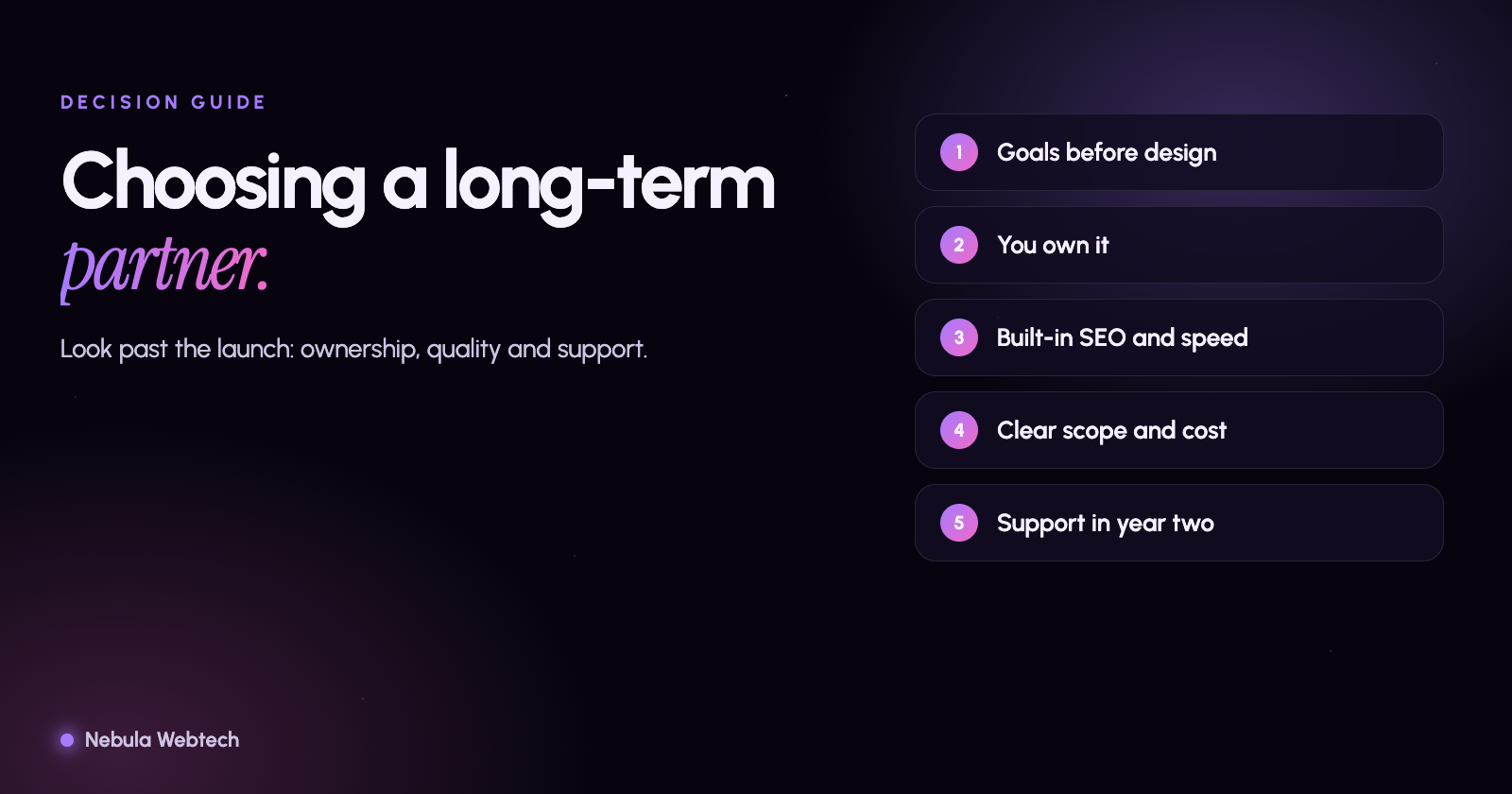
Choose a website development partner for long-term growth by looking past the launch: pick a team that understands your business goals, builds on technology you can own and move, is open about scope and cost, treats search, speed, accessibility and security as part of the build, and stays available afterward with clear support terms. A website is a business asset that needs care for years, not a one-time purchase.
Short answer: The best partner is the one who asks about your customers and goals first, puts ownership and support in writing, and can show how they will help the site grow after it launches.
Start with your goals, not your wish list
Before you speak to any company, write down:
- What the website must do for the business: leads, bookings, orders, hiring, credibility
- The numbers you will use to judge success, such as inquiries per month or booked appointments
- Who your customers are and how they find you
- What you have today: content, brand, accounts, analytics
- Your budget range and timeline, and what is flexible
A partner who starts by asking about these things is thinking about your business. One who starts with templates and colors is selling a design.
What makes a long-term partner different from a one-off vendor?
| One-off vendor | Long-term partner |
|---|---|
| Delivers pages and moves on | Plans for what happens in year two and three |
| Quotes by page count | Quotes by outcomes and effort |
| Leaves you to figure out hosting and updates | Explains and supports hosting, security and updates |
| Treats SEO as an add-on | Builds search, speed and accessibility in from the start |
| Controls your accounts | Gives you full ownership and access |
What should you check?
Ownership and portability
You should own the domain, content, design and code, hold your own hosting and analytics accounts (or have full admin access), and be able to move the site to another provider if you ever choose to. Ask for this in the contract.
Technology you can live with
Ask what the site will be built on and why. A common platform with a strong community is easier to maintain and hire for. A custom build can be the right choice when you have specific needs, as long as it is documented and you receive the code. Avoid proprietary systems that only one company can operate.
Search, speed, accessibility and security built in
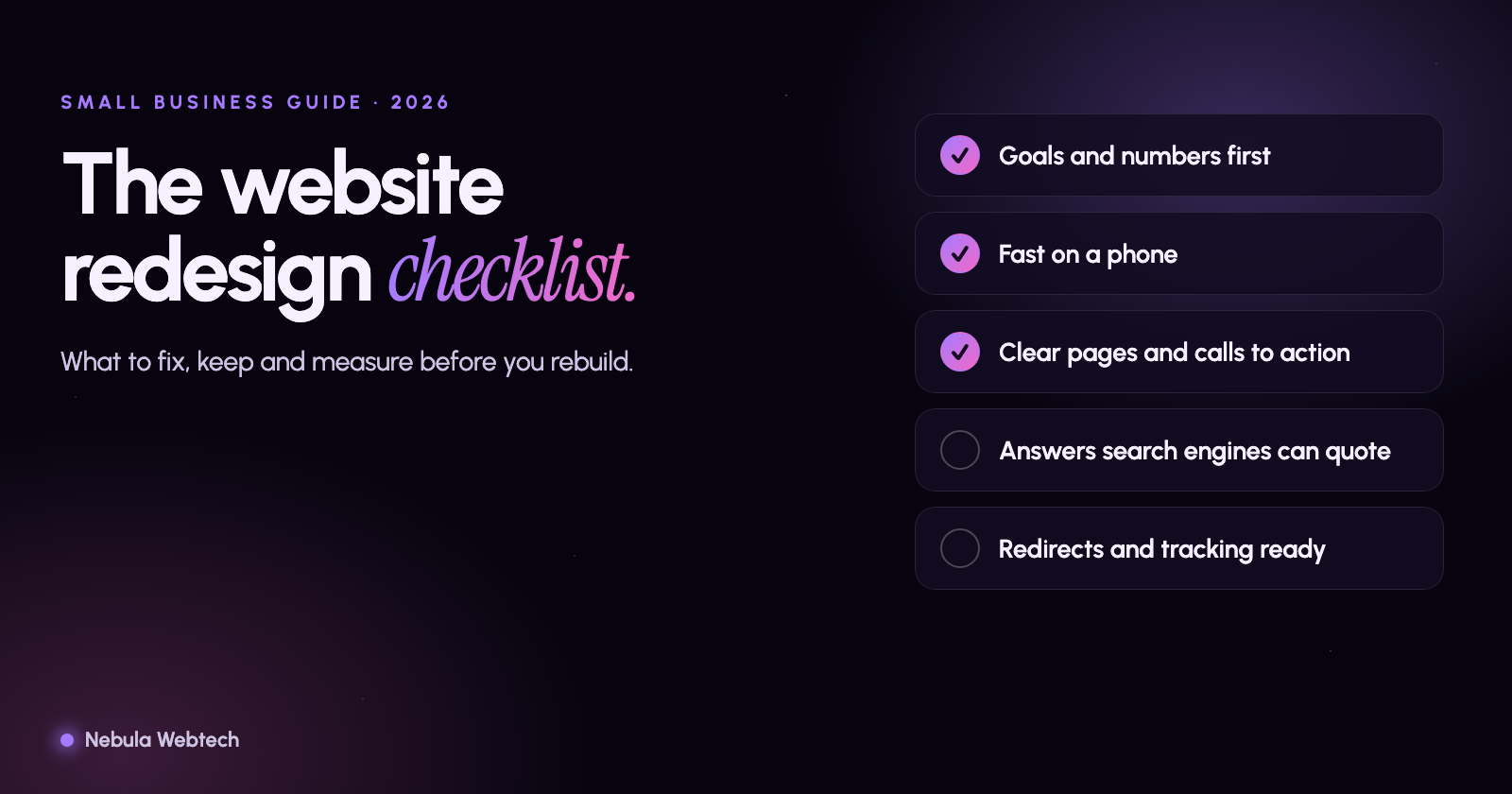
These should be in the plan, not extras. Look for clean page structure, redirects for old URLs, structured data, analytics, Core Web Vitals targets (2.5 seconds or less for Largest Contentful Paint, 200 milliseconds or less for Interaction to Next Paint, 0.1 or less for Cumulative Layout Shift), WCAG 2.2 AA accessibility and regular security updates. Our redesign checklist covers what to protect and measure.
Honest scope and pricing
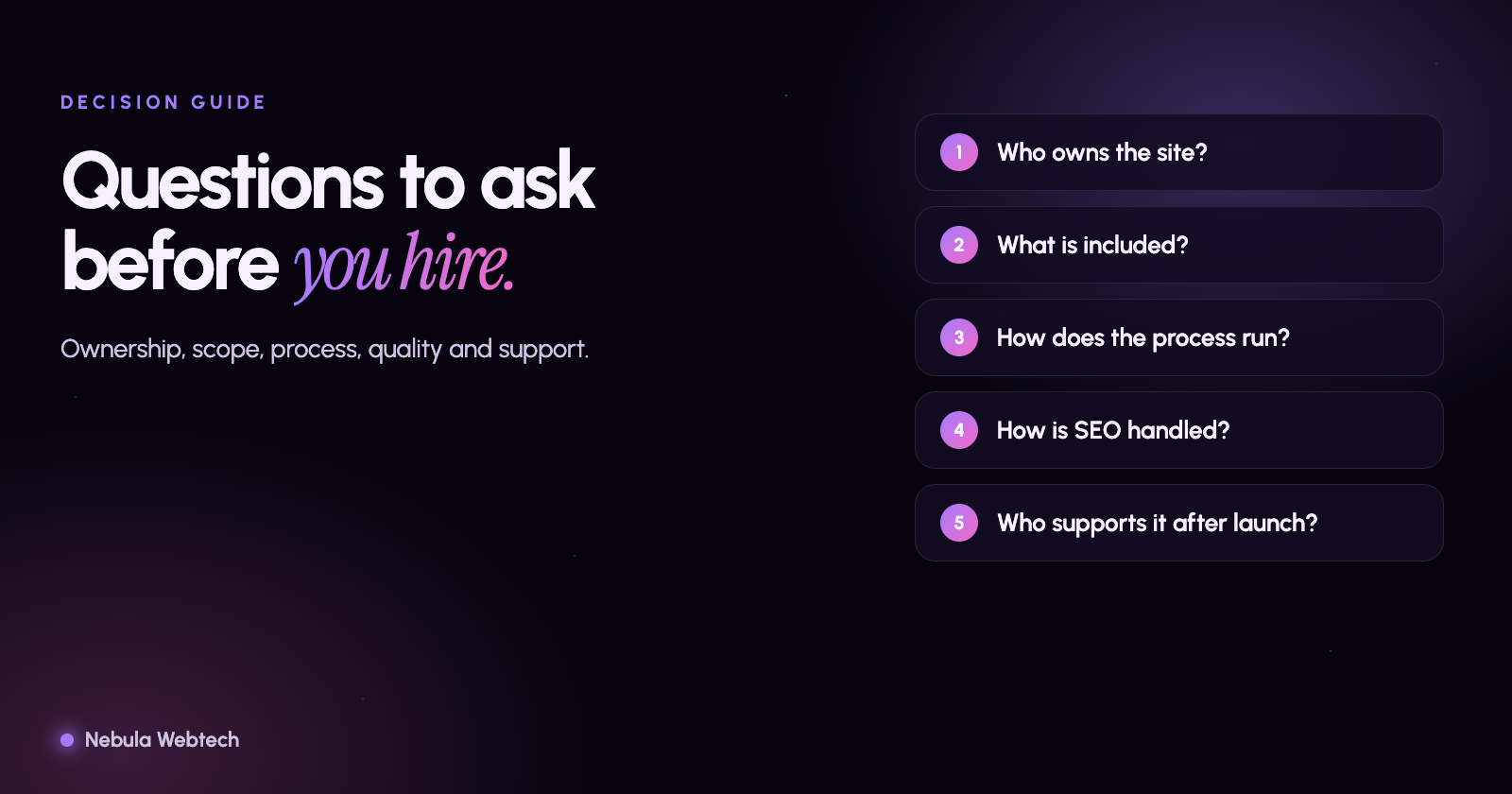
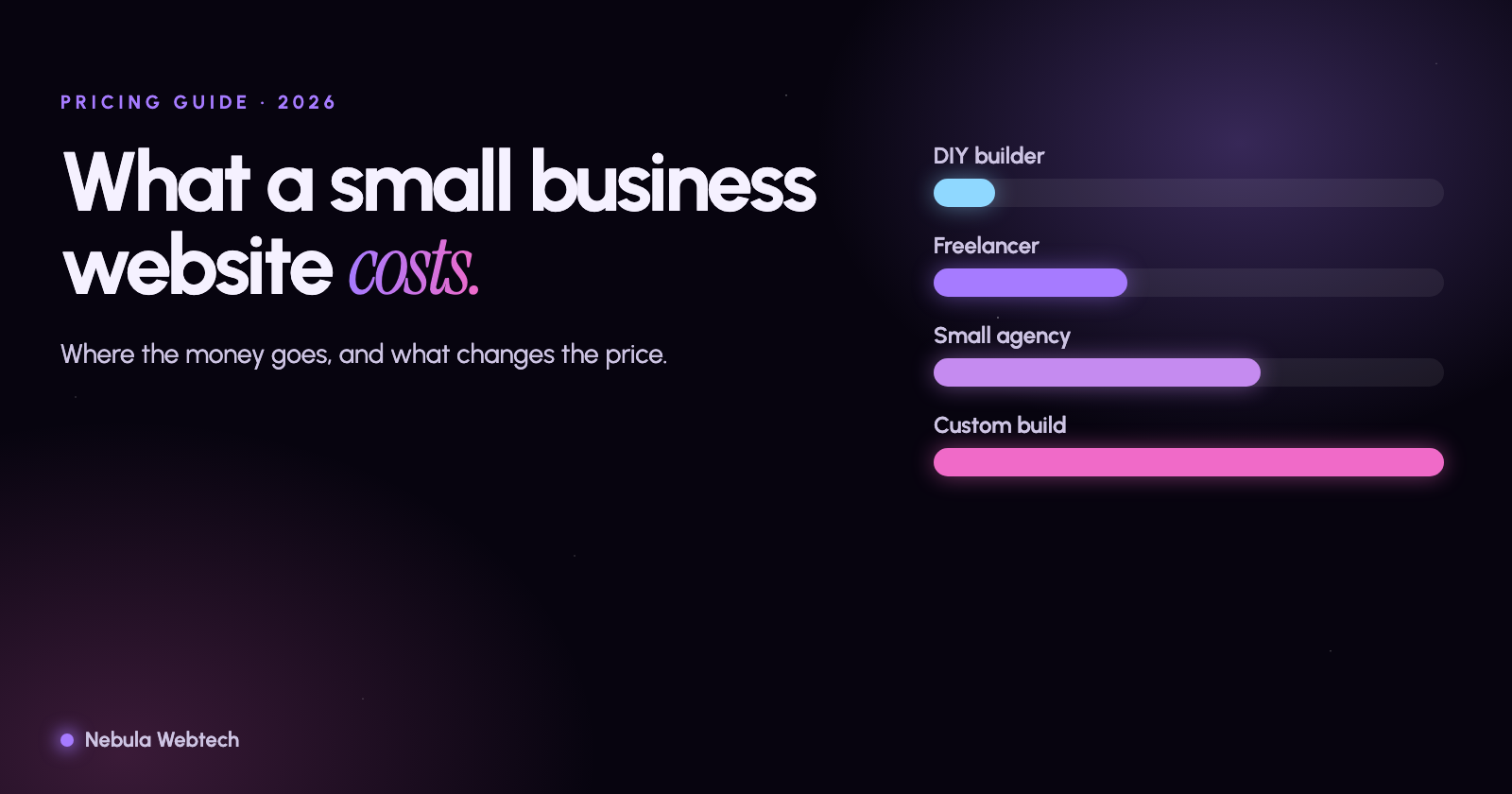
You should know what is included, what is not, and how changes are priced. See how much a small business website costs and questions to ask before hiring a website company.
Support after launch
Ask who will monitor the site, how quickly they respond and what the maintenance plan covers. Read why a maintenance partner matters.
Communication and fit
Pay attention to how quickly and clearly they answer questions before you hire them. Ask who your day-to-day contact will be. Good partners explain trade-offs, including when something you want is not worth the cost.
How do you evaluate proposals?
- Make a simple scorecard with your criteria: goals fit, ownership, scope clarity, quality practices, support, communication and price.
- Score each proposal from one to five on each row, and write down why.
- Talk to at least one past client for each finalist.
- Ask each finalist what they would do in the first 90 days after launch.
- Choose the best overall fit, not the lowest number.
What should the first year look like?
- Launch, followed by a check of analytics, forms and indexing
- A review at 30 and 90 days to see what visitors do
- Regular maintenance and security updates
- Content and search improvements based on real data
- A yearly plan for new pages, features or integrations as the business grows
Frequently asked questions
Should I pick a local company?
Local can help with meetings and understanding your market, but capability, communication and track record matter most.
Is it better to hire an agency or a freelancer?
Both can work. Freelancers can be flexible and affordable; agencies bring more roles and continuity. Check that either one has a plan if a person becomes unavailable.
When should I start talking to partners?
Before you are in a hurry. A good project needs time for planning and content.
Start a conversation
We are happy to be measured against this list. Request a project estimate and we will explain our approach, ownership terms and support plainly, or look at our web design and development services first.
- Web design
- Strategy
- Small business