6 min read
SEO vs AEO vs GEO: What Businesses Need to Know
SEO gets you ranked, AEO gets you chosen as the answer, and GEO gets you cited by AI tools. What each one means for a local business, and how to work on all three without tripling the effort.
NNebula Webtech
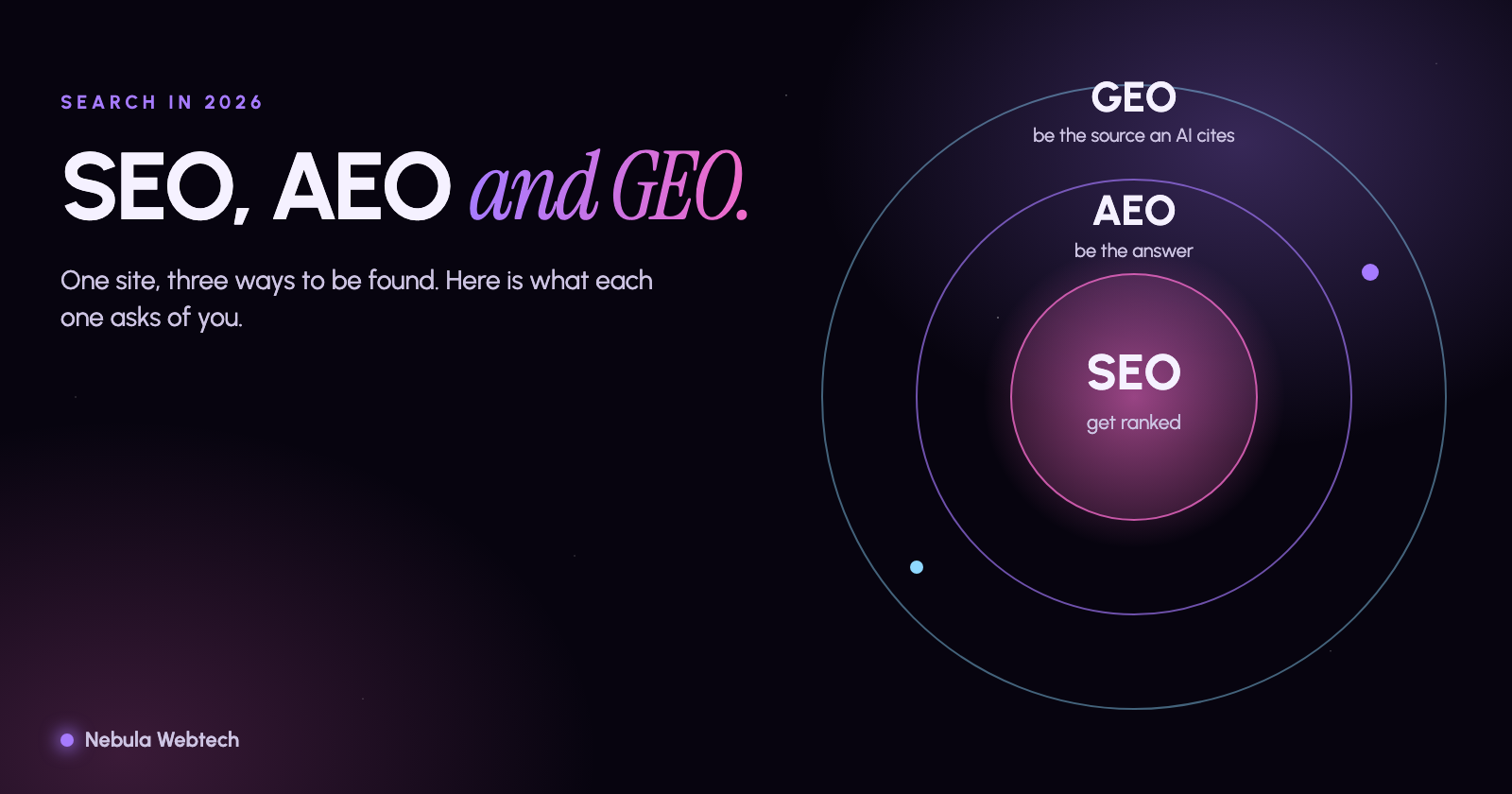
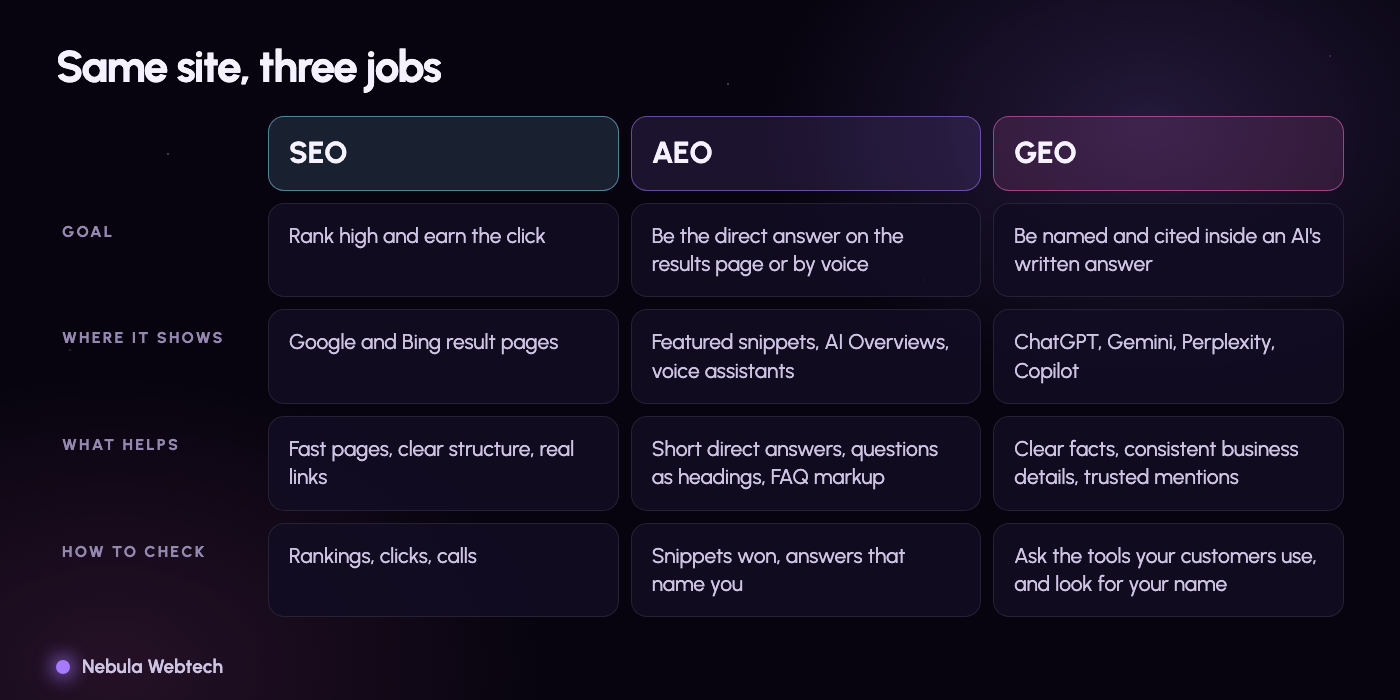
SEO gets your pages ranked in search results. AEO (answer engine optimization) gets your content picked as the direct answer: a featured snippet, an AI Overview, or what a voice assistant reads out loud. GEO (generative engine optimization) gets your business named and cited when a tool like ChatGPT, Gemini or Perplexity writes an answer. They are three layers of the same job, and the order matters: SEO first, then AEO, then GEO.
None of this replaces the others. A page that ranks well is more likely to be quoted. A business that is quoted and mentioned in several trusted places is more likely to be named by an AI. If you only have time for one thing this quarter, fix your SEO basics, because the other two stand on top of them.
SEO: be found and be chosen
Search engine optimization is the one you have heard of. You make your pages easy for Google and Bing to crawl and understand, you write content people want, and you earn trust through links and a good Google Business Profile. Success looks like rankings, clicks, calls and form fills.
For a local business, the core of SEO has not changed much:
- A fast site that works on a phone
- One page for each service, written for the people who need it
- Titles and headings that match what customers type
- A complete, accurate Google Business Profile with real reviews
- Links and mentions from other local and industry sites
AEO: be the answer
Answer engine optimization is about the moments when the search engine answers the question itself. That includes featured snippets, the "People also ask" boxes, AI Overviews at the top of Google, and voice assistants on phones and smart speakers.
People phrase these searches as questions: "how much does it cost to remove a tree near me", "is chiropractic safe during pregnancy", "what time does the coffee shop on Golf Road close". If your page answers that exact question clearly, you have a chance of being the one read out.
What helps:
- Answer first. Put a direct answer of one or two sentences right under the question, then add the detail.
- Use questions as headings. Write them the way a customer would say them.
- Keep answers short and complete. Around 40 to 60 words works for a snippet. Longer explanations can follow.
- Mark it up. FAQ, LocalBusiness and Article structured data tell machines what each part of the page is. Google now shows FAQ rich results only for a narrow set of sites, but the markup is still a clean way to label your answers.
- Be specific about place. For voice and "near me" searches, your service area, address and hours must be easy to find and match your Google Business Profile.
Voice search leans heavily on local intent and on the same few sources, so accuracy matters more than cleverness. If your hours are wrong online, a voice assistant will repeat the wrong hours confidently.
GEO: be the source an AI cites
Generative engine optimization is the newest layer. When someone asks an AI assistant for a recommendation, it writes an answer and often lists the sources it used. GEO is about being one of those sources, and about being named correctly in the text of the answer.
Nobody outside the AI companies knows the exact rules, and they change. What we can say from how these tools behave is this:
- They favor clear, factual pages. A page that states who you are, what you do, where, and for whom is easier to quote than a page full of slogans.
- They cross-check. A business that appears consistently on its own site, its Google Business Profile, directories, local press and industry sites is easier to trust than one that appears only on its own website.
- They need access. If your robots.txt blocks AI search crawlers such as OAI-SearchBot or PerplexityBot, you are asking not to be cited. Blocking is a legitimate choice for some publishers. For a local business that wants customers, it usually is not.
- They like original information. Your own pricing guidance, your own process, your own photos, answers to questions only someone in your trade would know. Generic text that says what every other site says gives them no reason to pick yours.
Be careful with anyone who promises you the top spot in AI answers. The answers vary by person, by day and by tool. You can improve your odds. You cannot buy a guarantee.
What this means for a small business
You do not need three separate strategies. You need one good website and a few habits.
Month one: the base. Run an audit, fix broken pages, speed up the slowest ones, and check your Google Business Profile. Our free website audit covers most of this in a few minutes.
Month two: the answers. Make a list of the 15 questions customers ask most. Write a clear answer to each, on the relevant service page or in an FAQ. Add the structured data. Link related pages to each other.
Month three: the proof. Ask happy customers for reviews. Get listed in the directories and associations your trade uses. Publish something only you can write: a pricing explainer, a how-we-work page, a local guide.
Every month: the check. Look at Search Console for the questions people searched. Then do what your customers do. Ask Google, ChatGPT, Gemini and Perplexity the questions you want to be known for, and note whether your business appears and whether the details are right.
Common mistakes
- Chasing AI tricks before fixing the basics. If the site is slow and the pages are thin, no amount of markup will help.
- Writing for machines. Stuffed phrases and awkward questions make the page worse for people, and people are who book the work.
- Letting facts drift. Different phone numbers, old hours, a service you no longer offer. Machines repeat what they find.
- Hiding content. Text that only appears inside an image, a PDF or a script is easy to miss.
- Copying competitors. If your page says what everyone else's says, there is nothing to cite.
Questions we hear
What is the difference between SEO and AEO?
SEO is about ranking your page and earning the click. AEO is about being the direct answer shown on the results page or spoken by a voice assistant, often without a click.
What is GEO?
Generative engine optimization means making your business easy for AI tools to find, trust and cite when they write an answer. It builds on strong SEO and consistent information about your business across the web.
Is SEO still worth it?
Yes. Rankings still drive most of the traffic that turns into customers, and AI answers draw heavily on pages that already rank and are well structured.
How do I check whether AI tools mention my business?
Ask them. Use the questions your customers would ask, in Google, ChatGPT, Gemini and Perplexity, and write down what each says about you. Repeat monthly. It is a rough measure, but it is the same view your customers get.
Can you guarantee a number one spot?
No honest company can, in search or in AI answers. What we can do is audit your site, fix what is holding it back, and write the answers customers are looking for. See how we approach SEO, AEO and digital marketing, or read our FAQ.
Where do I start?
Start with the free website audit, then contact us and we will go through the results with you and tell you where the quickest wins are.
- SEO
- AEO
- GEO
- Voice search
- AI search